

BV-SALA · In production
BiVelio Savings Layer
Spend less on every AI call.
What it is
BV-SALA sits between your application and the AI API. Before your prompt goes out, it applies a series of optimizations and modifications —compression, rewriting and removal of redundant context— so the same task consumes fewer tokens and therefore costs less.
How it works
- 1
Receives your prompt and the context you were about to send.
- 2
Applies optimizations: it removes redundancy, compresses and rewrites while preserving intent.
- 3
Sends the minimum sufficient version to the API you already use.
- 4
Returns the response to you along with the metrics of what was saved.
The paper, in detail
§1 The problem, formalized
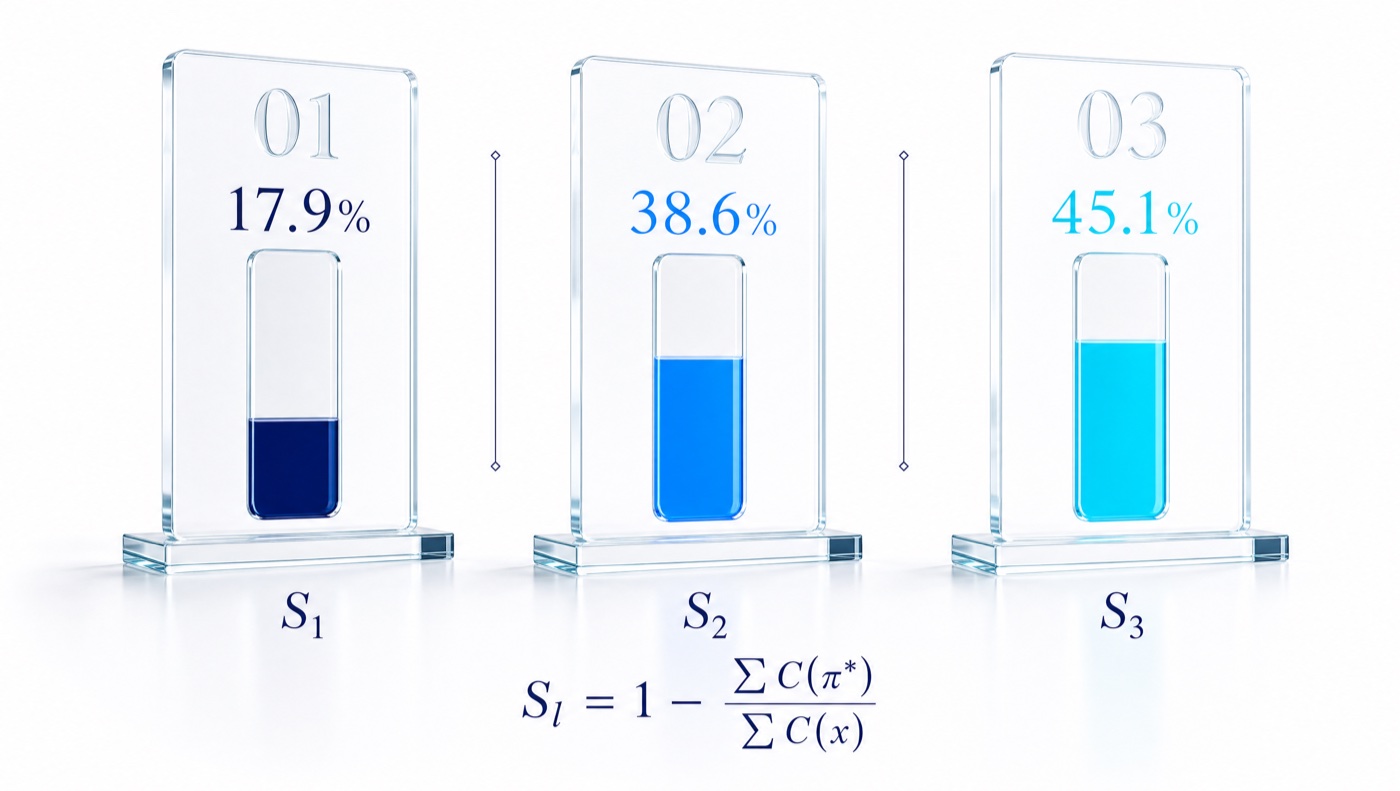
The provider charges a function essentially linear in tokens, counted with its own tokenizer. BV-SALA picks π* = argmin E[C(π(x))] subject to the quality contract Q ≥ τ. The intrinsic difficulty: Q is not observable before executing, so every transformation in the catalog carries its own guard — it applies only where accumulated evidence indicates intent is preserved, and in doubt the request travels untouched.
§2 Three ledgers that do not add up
Every optimized request is attributed to exactly one ledger by dominant mechanism: avoiding the call entirely, removing what never needed to be sent, or compressing what remains. Each figure speaks over its own denominator — aggregating them would count the same euro twice — and a ledger that does not clear zero against both control arms is published all the same, with its label, but never advertised.
§3 Measurement: the floor of the interval
Same model in two control arms — against an unoptimized integration and against the same integration already hand-optimized — with cost quoted by the provider's own meter, no modeled baseline. Scenarios are aggregated with a stratified bootstrap, weight one per scenario, and we publish the one-sided lower bound of the 95% confidence interval, never the point estimate. Hence the headline is advertised as ≥ 20.0% less bill on gpt-4o-mini: below what the stricter of the two controls clears.
§4 Net accounting and honest caching
Analyzing every request also consumes: all accounting is net, and the published saving discounts the cost of the layer itself. And a cache only counts if the reused answer is still valid: keys incorporate model, version, visible tools and effective context — on any difference, we call.
What it delivers
- Fewer tokens sent for the same task.
- Works with the APIs you already use, without switching providers.
- Savings metrics visible on every call.
Status
Fully productionized as a standalone product: savings.bivelio.com — licensed SDK on npm and savings measured against the provider's own meter, with its confidence interval alongside.
The figures we publish are measured, not estimated — never projections. All our research runs on NVIDIA inference and hardware.