
BV-PRGA · In production
BiVelio Privacy Gateway
Your sensitive data never leaves your system.
What it is
BV-PRGA is a privacy gateway placed before your prompt, document or file is sent to any AI API —DeepSeek, OpenAI, Anthropic and many others. It detects and retains sensitive data within your system, so it never travels to the external provider; only what is strictly necessary to complete the task goes out.
How it works
- 1
Intercepts the prompt, document or file before it goes out.
- 2
Identifies the sensitive data and keeps it within your system.
- 3
Sends only a protected version, without the sensitive information, to the external API.
- 4
Reconstructs the response with your data, back inside your environment.
The paper, in detail
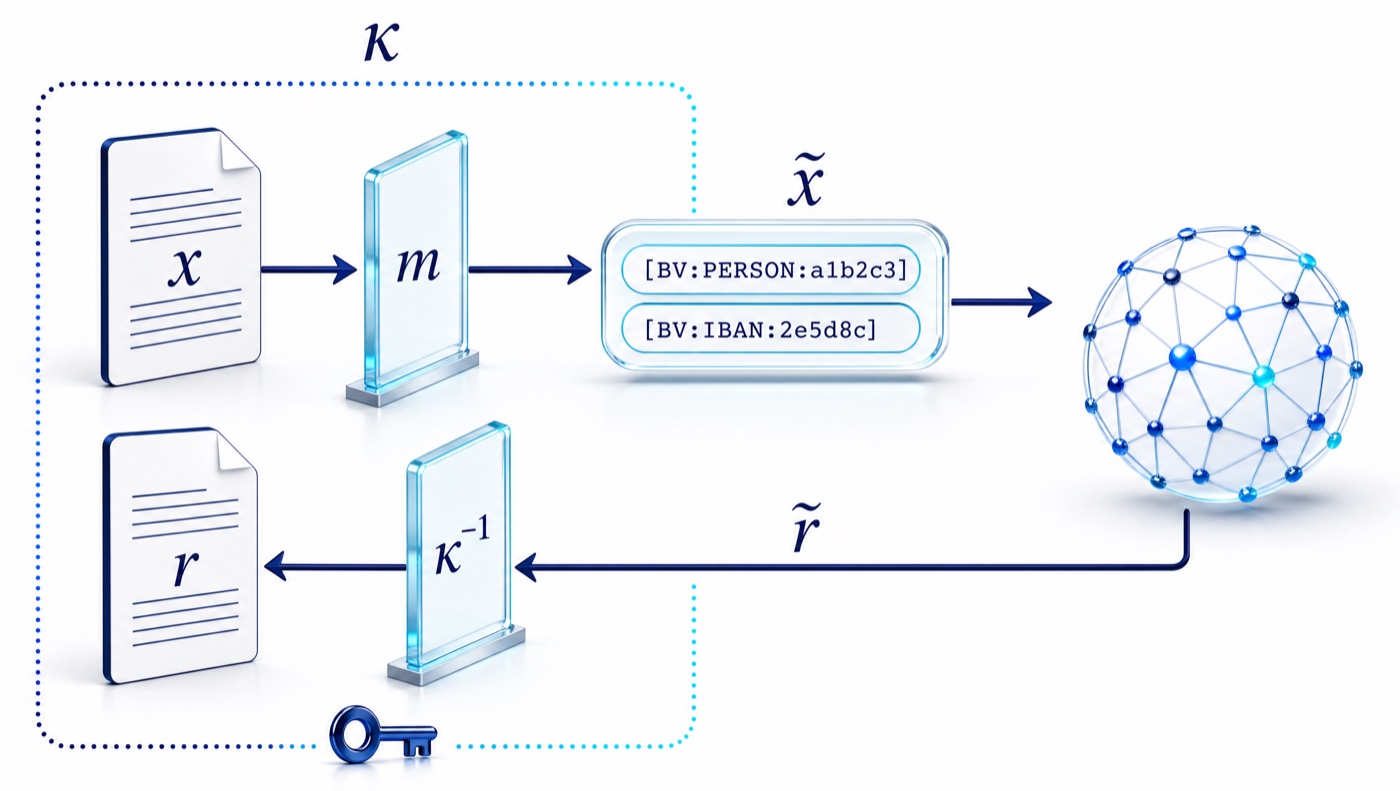
§1 The round trip
Outbound, m(x) = (x̃, κ): the protected version x̃ travels to the provider with stable markers like [BV:PERSON:a1b2c3] — consistent within the request, opaque outside it — while the map κ stays in your environment. On return, the response is reconstructed locally: r = κ⁻¹(r̃). Reversibility is local by construction, not by promise.
§2 Pseudonymizing is not blocking
What the task needs to reference is pseudonymized: people, identifiers, accounts, emails. Credentials and keys are blocked with an explicit decision — DENY — because a reversible marker of a secret is still a secret with one step of indirection. The meter records what was pseudonymized, what was blocked, and why the request did not leave.
§3 Fail-closed: in doubt, the gate shuts
Detection is a sequence-labeling problem and no detector is perfect. The honest question is not how often it is right, but what happens when it doubts — and the answer is structural: if analysis cannot complete with confidence, the default is not to send. A false positive costs a retry; a false negative, a data export that cannot be undone.
§4 What this gate is not
BV-PRGA reduces exposure and compliance surface — less personal data traveling to third parties — but it does not replace your data-protection legal framework: legal bases, processor agreements and impact assessments remain yours. The gate gives you a verifiable technical fact to rest them on: the sensitive did not leave.
What it delivers
- Sensitive information stays in your infrastructure.
- Compatible with any external AI API.
- Less exposure and compliance surface.
Status
Fully productionized as a standalone product: privacy.bivelio.com — free browser extension and self-hosted gateway on PyPI. It is an exposure-reduction mechanism, not a substitute for your data-protection legal framework.
The figures we publish are measured, not estimated — never projections. All our research runs on NVIDIA inference and hardware.